
There’s a particular moment each November when you realise the clocks have changed and your evening walk now starts in the dark. One week it’s golden light over the park. The next, you’re fumbling with a torch while your dog pulls towards a hedge you can barely see.
Winter walks can still be some of the best of the year. The crisp air, the empty paths and the smell of damp leaves all delight a dog. But they do ask a little more of us. A few small changes make the difference between a stressful trudge and a walk you both enjoy.
Dogs see better than we do in low light, but that doesn’t mean everyone else can see them. Cyclists, drivers and other walkers often spot a dog much later than you’d expect, especially a dark-coated one on an unlit lane.
Visibility also affects you. When you can’t see what’s ahead, you tense up, shorten the lead and hurry. Dogs notice that. A calm, well-lit walk makes for a calmer dog.
If you only change one thing this winter, make it visibility.
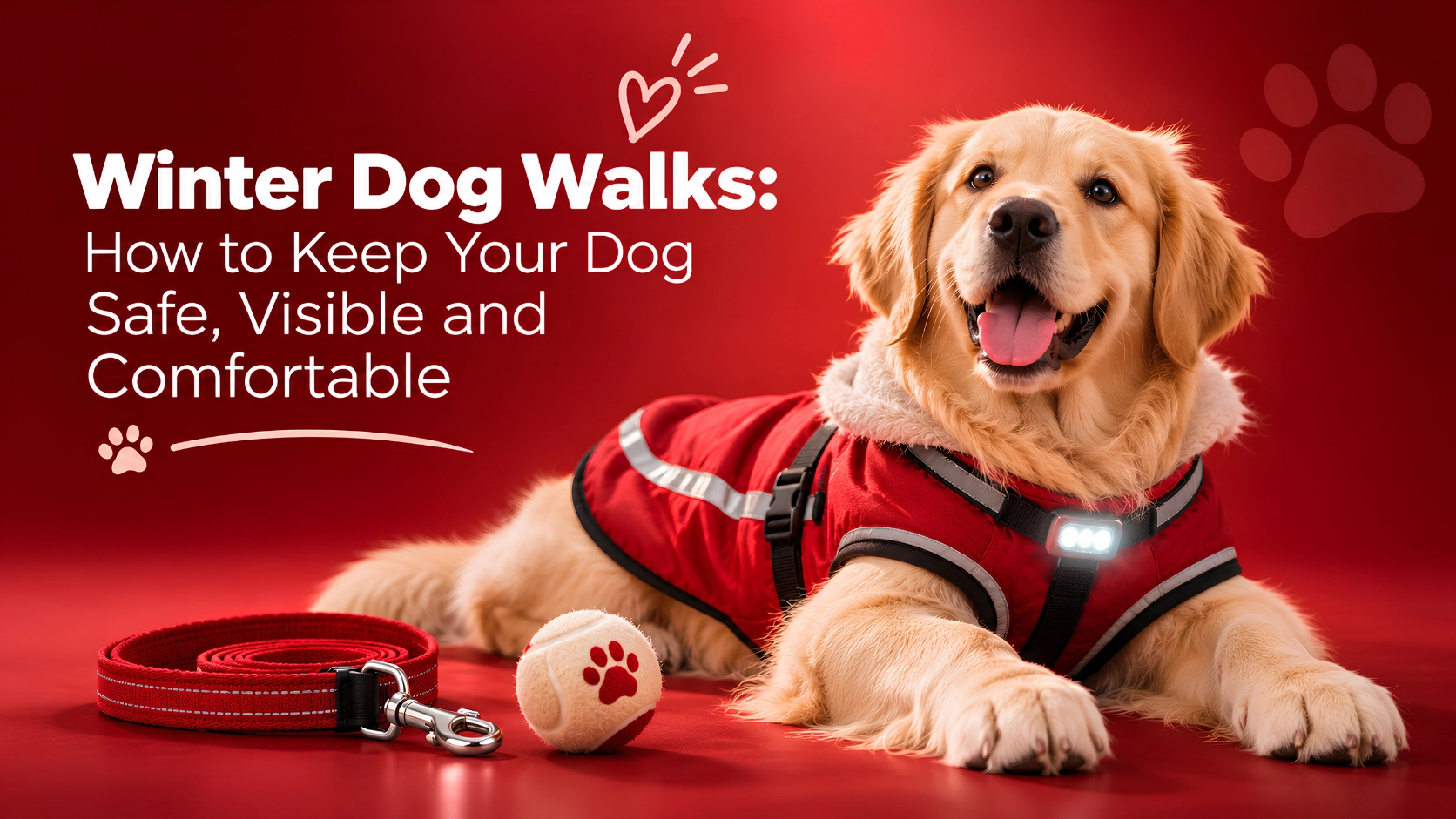
A reflective harness is one of the simplest upgrades. The reflective strips catch headlights from a good distance, which gives drivers more time to react. Look for one with reflective trim across the chest and back, so your dog is visible from the front and the side.
Fluorescent colours help in the dim light of late afternoon, before it’s fully dark. Bright yellow or orange stands out against grey pavements and wet leaves far better than black or brown.
You can also add a small clip-on LED light to the collar or harness. It’s cheap and light, and it lets you see your dog at a glance if they wander ahead. And don’t forget yourself. A reflective jacket or a head torch means you’re visible too, and you’ll have both hands free for the lead.
In winter, many owners find a harness works better than a collar alone. Cold, wet weather means muddy ground and slippery surfaces, and if your dog lunges or slips, a harness spreads the pressure across the chest instead of the neck.
Fit matters more than anything. You should be able to slide two fingers under the straps, and the harness shouldn’t rub behind the front legs. Winter coats can hide a poor fit, so check it every few weeks, especially if your dog’s fur gets thicker.
A collar is still useful for an ID tag. Keep one on at all times, with your current phone number. In the dark, a lost dog is much harder to find.
Short, sturdy leads are best on busy roads and pavements. For quiet parks and open fields, a long lead gives your dog room to sniff and explore without you worrying about recall in poor light.
A long lead in a bright colour does double duty. It lets your dog roam a little, and it’s easy to spot on the ground if you drop it. Just keep it away from roads, and be careful not to let it tangle around your legs on wet grass. Gloves are a good idea, since a wet nylon lead can burn if it runs through your hands.
Winter paths bring their own hazards. Salt and grit on pavements can irritate paws, so it’s worth wiping your dog’s feet with a damp cloth when you get home. Puddles can hide glass or sharp stones, and frozen ground can be hard on older joints.
Some dogs feel the cold more than others. Short-coated, small or elderly dogs may like a waterproof coat. If your dog is shivering, lifting their paws or trying to turn for home, listen to them and cut the walk short. A shorter walk twice a day often works better than one long one in freezing weather.
Plenty of us drive to a favourite walking spot, and winter means muddy dogs in the car. A few precautions keep everyone safe and your car tidy.
Dogs should always be secured while travelling. A car safety guard or a set of boot bars keeps your dog in the boot area and away from the driver, which is safer for everyone in a sudden stop. A protective seat cover or boot liner catches the worst of the mud and water.
Keep an old towel in the boot for a quick rub-down before your dog hops in. It takes ten seconds and saves a lot of cleaning later.
After a cold, damp walk, a warm and comfortable place to rest feels even better. This is where a good bed earns its keep.
Look for a bed with a supportive base and a soft, washable cover. Memory foam or orthopaedic styles are especially good for older dogs, whose joints tend to ache more in winter. Place the bed away from draughts, but not right next to a radiator, since dogs can overheat.
A dirt-control mat by the door is a handy extra. It gives wet paws somewhere to land, so the mud stays out of the rest of your home. Pair it with a quick towel-dry and a drink of fresh water, and your dog will settle in happily.
Before heading out, run through these quickly:
You don’t need to buy everything at once. Start with visibility, then add the rest as you find what suits your dog.
It’s easy to see dark evenings as something to endure. Many dogs, though, love the winter. They get to sniff, splash and run in cool air, and they don’t overheat the way they can in summer.
With a bit of preparation, you can enjoy it too. Pick a route you know well, stay visible, keep things unhurried, and finish with somewhere warm to curl up. The days will lengthen again before long, but there’s plenty of fun to be had until then.